By James Rose, Special to the Times Chonicle
“We are so back.” That may just be the melodic chorus one hears echoing across the vine rows of the South Okanagan and Similkameen valleys this fall as local wineries start to busy themselves with a bountiful grape harvest.
A relatively mild winter together with a hot, dry summer proved welcome relief to the embattled Okanagan wine industry which, after the January 2024 cold snap, suffered an estimated 97 per cent loss of the 2024 vintage and significant damage to the grapevines themselves.
Wineries struggled with a near complete lack of local wine production which forced them to consider using grapes from other regions such as the Fraser Valley and Washington state. The use of which was approved by the provincial government as a lifeline bypass of the strict rules set by the Vintners’ Quality Alliance. That process, importing grapes from the U.S., was not without considerable administrative headache in the form of endless paperwork and logistical challenges.
“But we were lucky the government lifted restrictions on where we could get our grapes,” said Christian Scagnetti, winemaker at Moon Curser Vineyards. From a producer in Washington state, we bought grapes that we don’t normally work with to keep it interesting.”
Management at Orofino Vineyards also bought grapes from the U.S. “We decided to go down to Washington, the Ancient Lakes area which is about three-hundred kilometres south from here and we purchased about a thousand cases worth of white wine and rosé,” said John Weber, Orofino’s winemaker.
This year’s harvest is markedly different.
“Our crop is ready to explode this year,” said Scagnetti, “Our yield should be back to our normal one-hundred-twenty tonnes, if not larger than the normal.” For reference, that amount of grape yields roughly eighty thousand bottles of wine for Moon Curser.
A bountiful harvest though does not necessarily mean good quality grape. “But because this summer has been hot and dry, it’s shaping up well,” Scagnetti said. “If weather conditions are cool and wet, that can introduce mold and mildew.”
Though it must be said that the perception of a good vintage remains a subjective judgment. “It all depends on the taste,” said Severine Pinte, winemaker and managing partner at both LaStella and Le Vieux Pin.
“For example, 2022 was pretty and elegant, whereas 2020 was quite concentrated and dense.” Nonetheless, Pinte is feeling optimistic about this year’s crop yield. Her team recently started harvest and will continue these efforts until late October.
“This year’s crop is one-hundred per cent better than last year because we didn’t have one last year,” said Weber. Orofino is in the Similkameen and was recognized at this year’s WineAlign awards as ninth overall in the top ten small wineries in the country.
“We feel super fortunate our vines recovered. We’ve even had to do some crop thinning because we look for premium grapes. It’s a nice luxury to be going through the vineyard cutting off grapes that don’t meet the cut.”
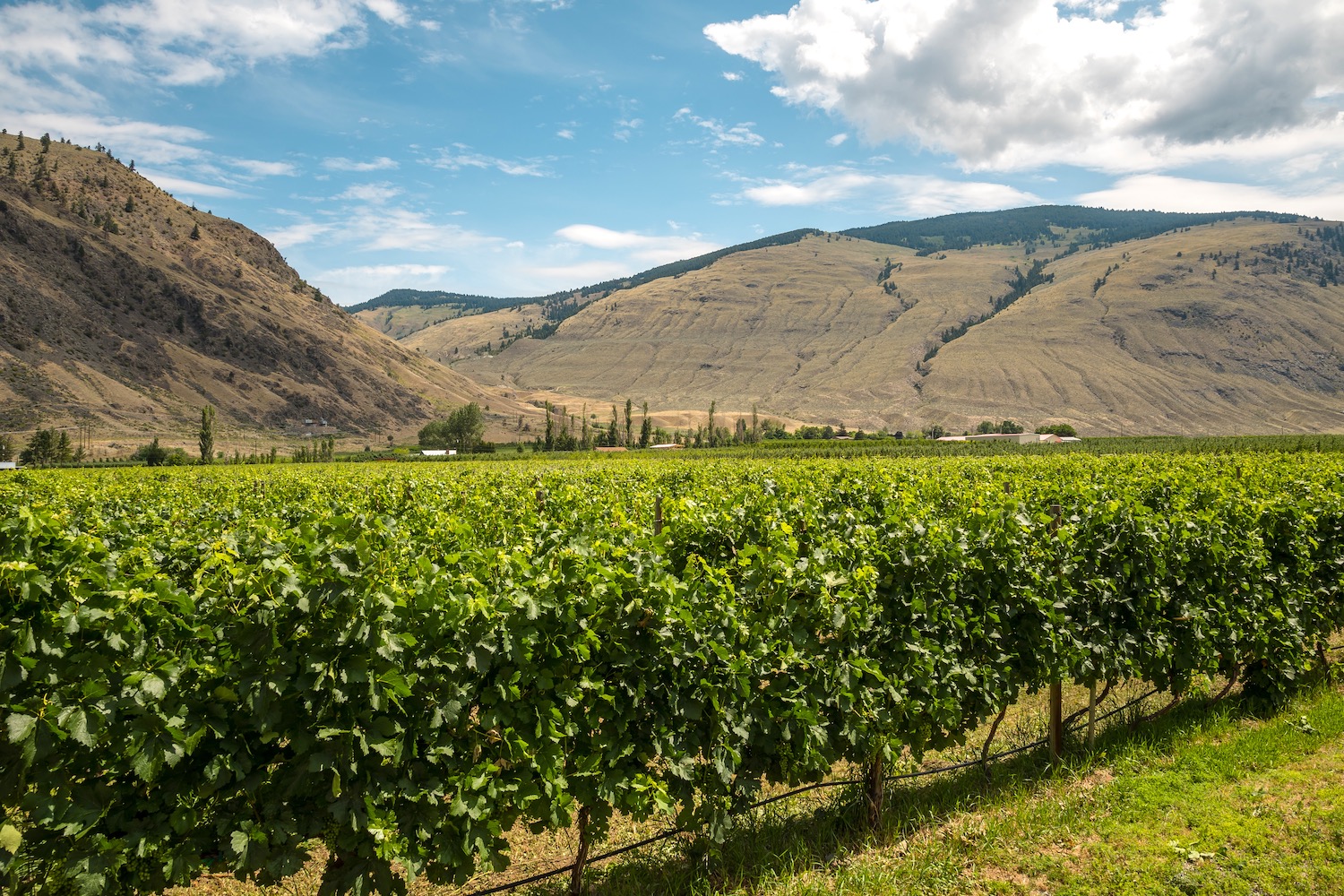
The vineyards in Similkameen’s Orofino Winery at Cawston.
Wine BC/Destination BC photo
The cold winters of 2023 (with an estimated sixty per cent crop loss) and 2024 did not come and go without lessons learned. Local vineyards are now starting to experiment and adopt practices to help protect their plants in the event of future cold snaps. These practices include experimenting with self-rooted vines, hilling and the use of geotextiles.
Hilling in the wine industry refers to the viticultural practice of mounding soil or other material around the base of grapevines, typically in late fall or early winter. Doing so insulates the lower parts of the vine, particularly the graft union, where the grape variety is grafted onto rootstock, or the base of the vine, both vulnerable to freezing temperatures. By covering these sensitive areas with soil, the vine is shielded from extreme cold, frost, or temperature fluctuations that could damage or kill it.
Geotextiles are fabrics used in the wine industry to improve soil stability, drainage, filtration, and erosion control. In viticulture, geotextiles have grown to play a niche but valuable role, particularly in vineyard establishment, maintenance, and environmental management. But there are challenges associated with geotextiles, cost being a leading one.
“We’ve done some experimenting with geotextiles and for now the experiment is not very conclusive,” said Pinte. “They are not so beneficial for us in our climate, because with the lack of snow we don’t get sufficient insulation.”
For Pinte, what is more important is to look at each plant more holistically. “If you use the plants as a money maker then you are going to lose,” she said. “If you use the plants as a money maker then you are going to lose,” she said. “It is more important to look at the different parameters and find a balance between the amount of money one can make compared to optimizing plant longevity.”
Meanwhile, Weber has embraced the practice of self-rooting as a direct response to the cold weather. Self-rooted vines are grapevines grown on their own root systems without being grafted onto a different rootstock. In the wine industry, they are significant for their historical, viticultural and quality implications.
“We looked at geotextiles, but they were very expensive,” said Weber. “We’ve incorporated different techniques such as hilling our vineyard, for example, and burying buds every year. We’re trying to increase the opportunities to protect our plants.”
Self-rooted vines were the norm historically until the phylloxera epidemic in the nineteenth century devastated vineyards worldwide. This led to widespread grafting onto resistant rootstocks. Also known as own-rooted, these vines often develop deep, robust root systems that can better access water and nutrients in challenging conditions, like drought. They are also believed to offer a purer expression of the grape variety and terroir since there’s no influence from a foreign rootstock altering nutrient or water uptake.
Yet despite the collective best efforts of local winemakers to optimize their crops, the power and volatility of Earth’s weather systems cannot be ignored.
“As romantic as the wine industry may be, we are still farmers at the end of the day,” said Scagnetti. “We are at the whim of Mother Nature.”
Moon Curser aims to start their harvest on September 10 and go into mid-November before pressing begins. Active work on their 2025 vintage will go until mid-December. “It is going to be a fantastic harvest. It’s so great to see all the fruit out there and for us to go back to a fully grown BC fruit harvest.”